

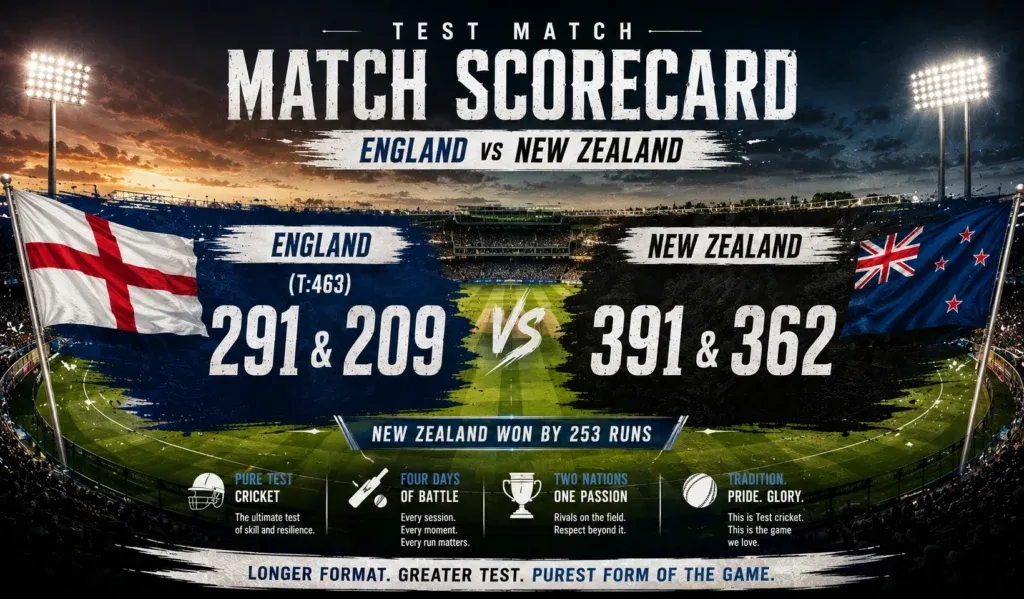
Test cricket scorecards contain many details that can be missed during a quick look. cricketmatchteam.com helps cricket followers explore match scorecards and understand the figures behind longer cricket contests. Unlike limited overs matches, a Test match can include several innings, changing batting conditions, and long periods of patient play. Its scorecard needs to be read with a little more attention.
A Test scorecard does not simply show which team scored more runs. It also records how the innings developed, how many wickets fell, and whether a team was dismissed or declared. These details can explain why a match ended in a win, draw, or another result permitted by the playing conditions.
Test Matches Have More Innings
A standard Test match is scheduled for up to five days. Each team normally has two innings available, although the match can end earlier depending on the result. This structure makes the scorecard different from a one-day or T20 match.
The first innings shows how many runs a team scored before being dismissed or declaring. The second innings records the team’s next batting effort when it comes to the crease again. The opposing team also has its own innings, so readers may need to follow four separate innings.
A scorecard may show the innings in order, with each team’s name and total displayed clearly. Some match summaries place the first innings totals beside one another before showing the second innings. Others list the innings in the order they occurred during play.
Readers should check the innings labels before comparing totals. A team scoring 350 in its first innings may later score 180 in its second innings. Those two totals belong to the same team but represent separate batting efforts.
First Innings Score Explained
The first innings is the opening batting effort for each team. It gives the side an opportunity to establish a total and put pressure on the opposition. The scorecard records the runs, wickets, overs, and individual batting figures.
A first innings total can be influenced by pitch conditions and the quality of the bowling attack. Some pitches offer movement early in the match, making batting difficult. Other surfaces allow batters to settle and build large partnerships.
Readers should not judge the first innings total only by comparing it with another match. A score of 280 might be competitive on a difficult surface. The same total could be modest on a flat pitch with little assistance for bowlers.
The scorecard can help explain the team’s progress through the innings. Check the top-order scores, middle-order contributions, and lower-order runs. This gives a better understanding of how the final total was assembled.
Second Innings And Follow-On
The second innings usually begins after both teams have completed their first innings. The team that batted first then bowls, while the other side begins its next batting effort. The scorecard records the new innings separately.
In some Test matches, the team batting first may lead by a large margin. Under the relevant playing conditions, the opposing captain may be able to enforce the follow-on. This means the team that batted second must bat again immediately instead of waiting for the usual sequence.
The follow-on is not automatic in every situation. It depends on the lead, match rules, and the captain’s decision. Readers should check the scorecard or match summary to see whether the follow-on was enforced.
When a team follows on, the innings sequence can look unusual. One team may bat twice before the other team begins its second innings. This is why Test scorecards should be read through the innings labels rather than by assuming a fixed order.
Understanding The Match Lead
The lead shows how many more runs one team has scored than the opposition at a particular stage. It is usually calculated by comparing the completed innings totals. The lead can change as the match continues.
If the first team scores 400 and the second team scores 300, the first team has a lead of 100 runs. This means it has scored one hundred more runs during the completed innings. The match is not necessarily over because both teams may still have another innings.
A lead can create pressure for the team batting next. It may need to score quickly or avoid losing wickets while trying to reduce the difference. The scorecard helps readers understand how much work remains.
A lead should not be confused with the final target. The lead is the difference between completed innings totals, while the target is the number of runs required to win. The target becomes clear when the relevant innings have been completed or declared.
Target In A Test Match
The target is the number of runs a team must score to win. In a Test match, it usually becomes available after the team batting first has completed its innings and the opposition has finished its second innings. The scorecard then shows the required total for the chasing side.
For example, if one team scores 350 and the other team scores 280, the first team has a lead of 70 runs. If the first team then scores 200 in its second innings, the chasing side needs 271 runs to win. The target includes one more run than the total lead.
A Test chase can last several sessions. The batting team may need to balance scoring with protecting wickets. The scorecard shows the runs required, wickets lost, and current batting figures during that effort.
A target does not guarantee that the match will finish with a win. The chasing team may run out of time or lose all its wickets before reaching the required score. In that case, the result depends on the final match situation and playing conditions.
Declarations And Their Meaning
A declaration happens when a batting captain voluntarily ends the team’s innings. The team does not need to lose all ten wickets before declaring. The captain may choose to declare when enough runs have been scored and sufficient time remains for the bowlers to dismiss the opposition.
The scorecard usually marks the innings as declared. It may show the total runs and wickets at the time the declaration was made. Readers should not assume that the team was all out simply because its innings has ended.
Declarations are often used to create a result opportunity. A captain may declare with a substantial lead and leave the opposition enough time to bat. This can increase the chance of taking ten wickets before the match ends.
A declaration can also influence the required target. The scorecard records the declared total, which becomes part of the match calculation. Understanding the declaration helps readers follow why the next innings began when it did.
All Out And Wickets Lost
A team is all out when it has lost ten wickets in a standard Test innings. The scorecard then shows the final total and the dismissal details for each batter. The innings ends because the batting side no longer has enough eligible batters to continue.
The number of wickets lost is important when comparing innings. A team scoring 320 for nine wickets may be close to being dismissed, while a team scoring 320 for four wickets may have built a more stable position. The total alone does not show the same level of control.
A scorecard may also show a batter who remained not out when the innings ended. This can happen when the other batters have been dismissed or when the captain declares. The not out status should be checked alongside the innings result.
Readers should also remember that a Test innings can end through a declaration or other match conditions. It does not always finish with ten wickets lost. The innings status explains how the batting effort ended.
Overs In Test Scorecards
Test scorecards display overs bowled by each bowler and sometimes the total overs completed by the team. Overs help readers understand how much time and bowling effort went into the innings. They also provide context for the scoring rate.
The notation works in the same way as limited overs cricket. A figure such as 86.4 overs means eighty-six complete overs and four legal balls. The digits after the decimal point represent balls, not a decimal fraction.
Test matches can involve long spells from fast bowlers and spinners. The overs column helps readers see how the bowling workload was shared. A bowler who completes thirty overs has contributed a substantial spell.
Overs should not be compared without considering match conditions. A team batting for many overs may have been trying to survive difficult bowling. Another team may have scored quickly while facing less movement or a flatter pitch.
Batting Figures In Tests
Batting figures in Test cricket include runs, balls faced, fours, sixes, and dismissal details. These statistics help readers understand each player’s contribution. The scorecard may also show the strike rate, although it is not always the main focus in longer formats.
A batter scoring 80 runs from 200 balls may have played a patient innings. This could be valuable when the team needs to protect wickets or bat through a difficult session. The scorecard records the runs and balls, but match context explains the purpose.
A quick innings can also be important in Test cricket. A batter scoring 60 from 70 balls may help the team increase its lead before declaring. The value of that effort depends on the target, time remaining, and wickets available.
Readers should compare batting figures with the innings situation. A defensive approach may be sensible in one session and costly in another. Test cricket requires more context than a simple strike rate comparison.
Bowling Figures Over Long Spells
Test bowling figures often show larger workloads than limited overs scorecards. A bowler may deliver many overs across several sessions. The scorecard records overs, maidens, runs conceded, and wickets taken.
A bowler taking five wickets in an innings is often described as taking a five-wicket haul. This is a notable achievement in cricket and can have a major effect on the match. The scorecard may highlight the figure in a match summary.
Economy rate can still be useful in Test cricket. It shows how quickly runs were conceded per over. However, wickets, pressure, and the ability to bowl long spells also matter when assessing a bowler’s contribution.
A bowler may keep the scoring rate low for a long period without taking many wickets. This can help the fielding team create pressure and force batters into mistakes. The scorecard should be read alongside the match situation.
Session Scores And Progress
Test matches are often divided into sessions across each day. A scorecard may provide session summaries or show how many runs were scored during particular periods. These details help readers follow the pace of the match.
A team scoring 90 runs in one session may have made a strong start. Another session with 40 runs and several wickets may have been dominated by the bowling side. The total and wickets together explain the session’s character.
Session information can also help readers understand a declaration. A captain may decide to declare after a session when the team has built a large lead. The remaining time then becomes important for the bowlers.
Not every scorecard includes detailed session breakdowns. Some providers offer them through commentary or match reports. Readers can use those details when they want a deeper view of the match.
Draws And Match Results
A Test match can end in a win, loss, draw, or tie. A draw usually occurs when the match reaches its scheduled end without a team completing the conditions required for victory. This can happen when time runs out during the final innings.
A tie is different from a draw. A tie occurs when both teams finish with exactly the same total in the relevant completed match situation. Ties are rare in Test cricket and require a very specific result.
The scorecard should show the final result clearly. It may include the winning margin in runs or wickets. A drawn match may be listed without a winning margin because neither team completed a victory.
Readers should check the result line after reviewing the innings totals. This avoids confusing a team with a large lead for a team that has already won. The final result depends on the match rules and completed innings.
Conclusion
Test cricket scorecards contain more innings information and match context than shorter formats. First innings totals, leads, declarations, targets, and follow-on decisions all influence how the result develops. Understanding these details helps readers follow longer matches with greater confidence. Explore cricket scorecard information and Test match figures on cricketmatchteam.com to understand the numbers behind each session.
Read also :-
pakistan national cricket team vs australian men’s cricket team timeline