

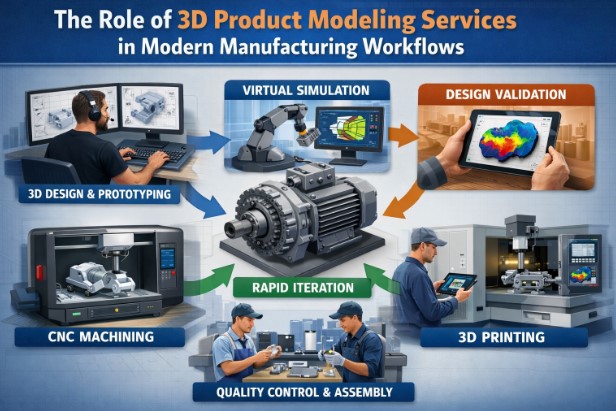
Over the last decade, the dynamics of manufacturing workflows have changed dramatically. Increased product complexity, reduced development cycles, and ever-growing demands on quality force manufacturers to reconsider how products should be designed, validated, and produced.
Traditional workflows based on 2D drawings with late-stage physical prototyping cannot respond effectively to these pressures. In this respect, 3D product modeling services provide integral elements in today’s manufacturing workflow and allow for faster decision-making, higher levels of accuracy, and smoother team collaboration.
Rather than being a design activity in its own right, 3D modeling now pervades every stage of the manufacturing pipeline.
From Concept to Manufacturable Design
Modern manufacturing really begins long before production starts. Decisions about form, structure, and material made early in the stage have a direct impact on cost, feasibility, and time-to-market.
3D modeling is critical in this stage because the teams are able to:
- Visualize products in proper three-dimensional form
- Measure proportions, dimensions, and spatial relationships
- Identify feasibility concerns before engineering investment
Instead of working from abstract drawings, manufacturers work from accurate digital representations reflecting real-world constraints. The clarity reduces ambiguity so that design intent is aligned with manufacturing capability at the very outset.
Improving Design–Engineering Alignment
Probably the most common problem in manufacturing workflows is misalignment between the design and engineering teams. Even slight misunderstandings can lead to redesigns, delays, and cost overruns.
What spans the divide is the common reference: detailed 3D models. Engineers review how the designs will be manufactured, assembled, and serviced; designers get immediate feedback on technical limitations.
This alignment helps:
- Reduce Design Iterations
- Improve manufacturability
- Avoid late-stage engineering changes
Because teams are working from the same digital model, decisions are faster and more confident.
Enable Early Validation and Error Detection
Late-stage manufacturing workflow errors are expensive to find. Tooling changes, production stoppages, and rework can quickly erode margins.
3D modeling allows for early validation, such as digitally checking by teams:
- Fit and clearance of components
- Assembly sequences and tolerances
- Potential interference or collision problems
The 3D product modeling services inside the workflow allow the retransfer of validation to the early phases when changes are faster and cheaper to implement.
Reducing Dependence on Physical Prototyping
While physical prototypes are critical, modern manufacturing does not rely on these as a primary means of validation. Each requires time, material, and coordination-all slowing development.
Accurate digital models enable manufacturers to:
- Validating many design iterations virtually
- Reduce the number of physical prototypes required
- Reserve prototyping for final verification rather than exploration
This certainly speeds up the pace of development and supports cost containment, especially when highly complex or high-volume products are involved.
Production Planning and Tooling Support
Manufacturing workflows involve everything from design and engineering to production planning. Tooling, fixtures, and even assembly processes depend on accurate product data.
3D models help in production planning in the following ways:
- Providing exact dimensions to the design tooling
- Planning assembly layouts with teams
- Automation and CNC workflow support
Production teams working directly from validated digital models make the transition from design to manufacturing smoother and more predictable.
Improving Supply Chain and Vendor Collaboration
Manufacturing today generally requires the involvement of more than one supplier and other external partners. Design intent must be clearly communicated across organizational boundaries.
3D models enhance collaboration by:
- Providing a universal visual language
- Reduce interpretation errors from 2-D drawings
- Ensure that suppliers work with the latest design version
Quality Control and Process Consistency
Manufacturing requires consistency: Products should not only meet specifications once but also repeatedly at scale.
Accurate 3D models enable quality control by:
- Used as a reference for inspection or measurement
- Helping to determine tolerances and acceptance criteria
- Digital Inspection and Verification Process Support
Anchoring quality checks to validated digital models helps manufacturers maintain tighter control over production outcomes.
Integration with Digital Manufacturing Systems
The digitalization has come to the manufacturing workflows in systems including CAD/CAM, PLM, and ERP. The 3D model is the center of information provision within these systems.
This integration offers:
- Smooth data exchange between design and production
- Improved tracking of revisions and changes
- Improved traceability throughout every stage of a product’s life cycle
Digital continuity reduces manual handoffs and ensures that everyone is working with consistent and current information.
Supporting Variants and Product Customization
Many manufacturers today are offering customized or configurable products, managing multiple variants using traditional workflows can quickly become inefficient.
3D modeling empowers teams to:
- Create parametric designs
- Update variants without model rebuilds
- Ensure consistency across product families
This flexibility supports mass customization while keeping workflows manageable.
The Role of External Expertise within Manufacturing Workflows
With the increase in manufacturing workflow complexity, most companies use third-party partners to bolster their design and visualization capabilities.
Working with a professional 3D visualization company supports manufacturers to scale modeling capacity, maintain quality standards, and hit tight timelines without overloading internal teams. If integrated correctly, such external support is a seamless extension of the manufacturing workflow rather than some kind of disconnected service.
Reduce Risk & Improve Time-to-Market
Finally, contemporary manufacturing workflows are targeted either at risk minimization or faster product delivery. And digital modeling directly supports both objectives.
With early validation enabled and with better communication and transition between stages, manufacturers avoid costly surprises and maintain projects running without major hiccups.
Conclusion
Modern manufacturing is all about precision, speed, and coordination across multiple teams and systems. Embedding 3D product modeling services within manufacturing workflows offers far better visibility, strong alignment, and greater control right from concept through to production. 3D modeling has therefore become a key enabler of the new wave in digital, integrated manufacturing processes regarding efficiency, quality, and long-term competitiveness.
